
Banding 750 Royal Terns: A Day in Bird Conservation
How does a team of biologists and volunteers band 750 Royal Terns in a single day? As an avid birder with a career devoted to bird conservation, I jumped at the chance to find out firsthand when a colleague invited me to join a team of professional biologists banding terns as part of a Georgia Department of Natural Resources (GA DNR) project investigating Royal Tern survival, dispersal, migration, and more.
When I arrived at the boat launch in Brunswick a few minutes ahead of the appointed 7 AM start time on an early July day, life jacket, camp chair, and backpack in hand, a cheerful crew of biologists and volunteers were already gathered. Once we were given instructions for the morning by GA DNR biologist and project manager Tim Keyes, we boarded a few boats and headed out to Bird Island, a dredge spoil site near the mouth of Saint Simon’s Sound that was created by the Army Corps of Engineers in 2007 as dedicated habitat for birds.
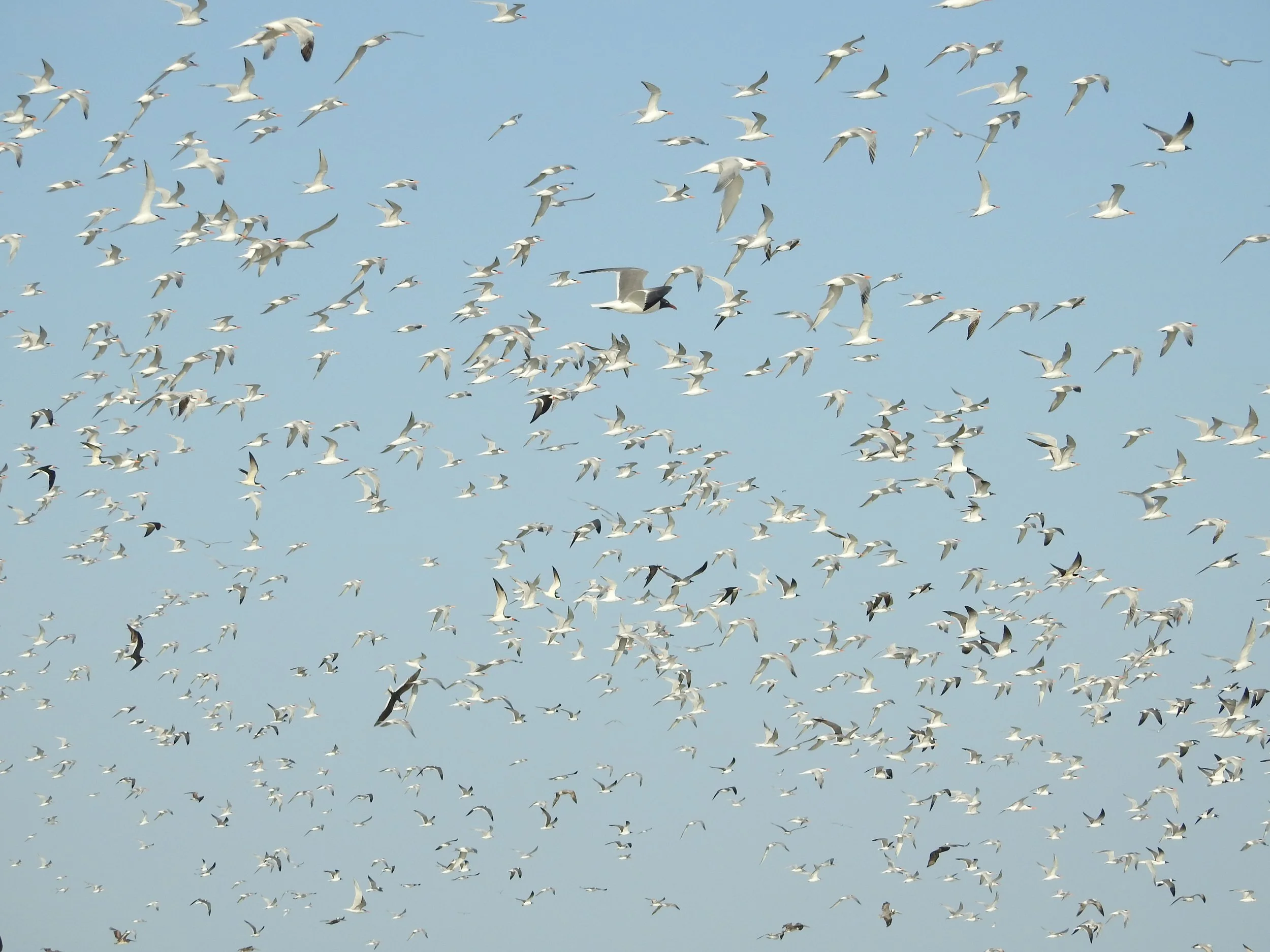
A huge flock of terns, gulls, and skimmers on the Georgia coast
If you’ve never experienced a large nesting colony of seabirds at close range, imagine the sights and sounds (and smells) of thousands of birds flying overhead making their raucous calls while thousands of chicks shriek from the ground below. It’s quite a (loud) spectacle! Species nesting on Bird Island since 2009 have included Gull-billed, Royal, Least, and Sandwich Terns; Black Skimmers; American Oystercatchers; Wilson’s Plovers; Laughing Gulls; and Brown Pelicans. Our mission for the day was focused on Royal Terns, which number in the thousands at this particular site.
Royal Terns inhabit warm coastal marine waters during their entire life cycle. They typically rest and forage near shore, though they may venture up to fifty miles offshore or head inland along saltwater bays and rivers when seeking food for their young. They nest in dense colonies, up to 10,000 birds, choosing low-lying islands that are inaccessible to terrestrial predators, offer good visibility of their surroundings, and have adjacent shallows for feeding. Along the Georgia coast, they have used dredge spoil sites like Bird Island with great success.
Both members of mated pair select a nest site and make a scrape, defecating on the rim, perhaps to reinforce the nest against possible flooding. After a few weeks, the nest rim hardens and fades, giving the colony a whitewashed appearance. Females typically lay their eggs synchronously within a subsection of a colony, each female laying one, sometimes two speckled eggs that are well camouflaged on sand and gravel. Partially precocial young hatch after roughly one month of incubation by both parents.
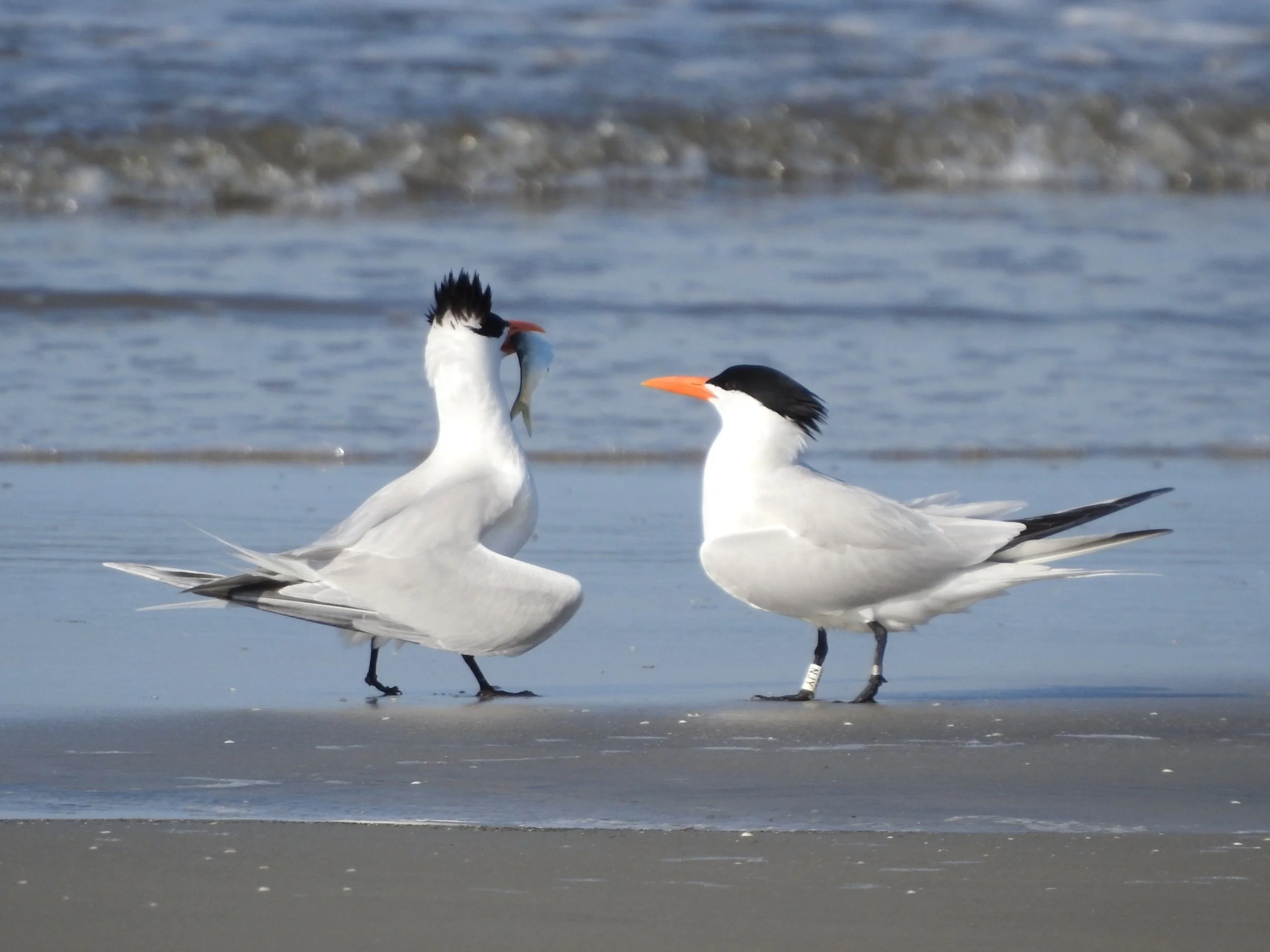
Males court females by bringing fish. Notice the bands from a previous summer on the tern on the right.
Within a day or two, chicks leave the nest and congregate in a “creche” (an old French word for crib), which can contain thousands of chicks ranging from 2–35 days old, though each chick depends entirely on its own parents for food. I estimated at least 2000 Royal and Sandwich Tern chicks in the creche on Bird Island, predominantly Royal Terns. How adults single out their own chick(s) among thousands is mind-boggling! Research suggests that they hone in on their chick’s unique calls and appearance. When confronted with a threat, the creche huddles together, shuffling away from the danger. This behavior enables biologists and researchers to effectively corral chicks into a temporary holding pen where they can be contained for banding.
Upon landing on Bird Island, our group split into two teams to flank the creche. I soon realized the seriousness of the warning to place each step carefully when someone pointed out a hatchling gull in a grassy area just a few feet away from the line we were forming. Though I’d been scanning, I hadn’t detected the occupied scrape until I was almost on top of it. We formed a long, loose line, then started closing in on the creche, pressing the birds slowly and methodically toward the funnel of fabric fencing that had been set up a few days before. Once the chicks were contained, everyone hurried to the beach to set up tables, chairs, and tents. Although I would have loved to spent time taking photos of the amazing bird life around me, with hundreds of tern chicks to band and the rising sun already starting to blaze, I didn’t want to be “that volunteer.” Snapping shots of (adorable!) baby pelicans would have to wait for another day, as our goal was to complete the task as quickly as possible to minimize the chicks’ stress and exposure, although Tim assured us that the adults would continue to feed their young in the corral.
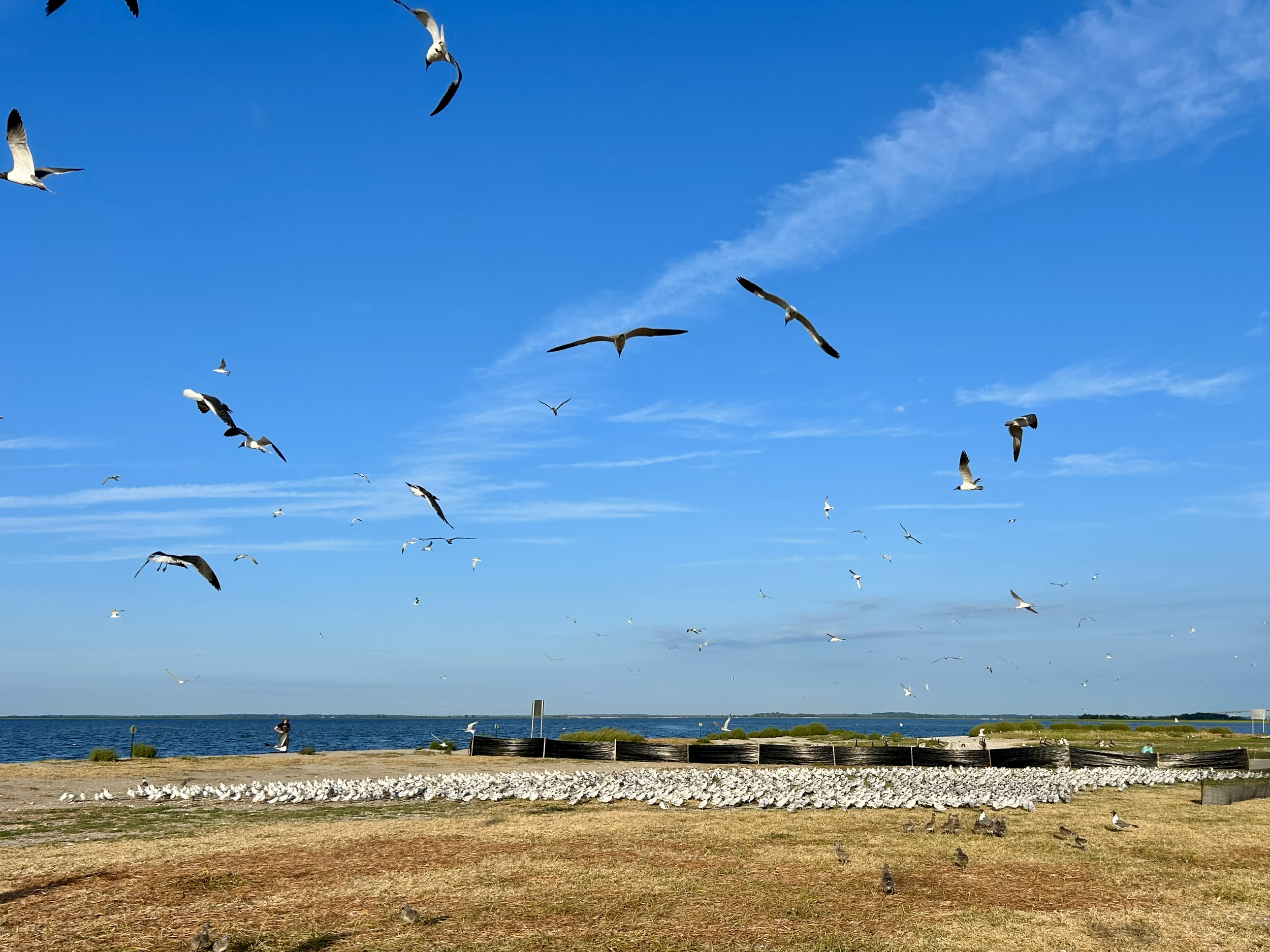
Corralling the creche of tern chicks
Immediately, teams of three or four volunteers assisting a licensed bander began ferrying terns in soft-sided carriers between the corral and the canopies, holding birds, applying bands, recording the band numbers in logs, and releasing the birds back to the creche. Each bird was fitted with two different bands (one on each leg), a metal band with a unique nine-digit identification number and a field-readable red band with three large white letters and/or numbers that can be seen with good optics. Band numbers are sent to the Bird Banding Laboratory with the U.S. Geological Survey. When banded birds are reported, scientists can gain important insights into the bird’s movements, longevity, and other life history. To say I was thrilled to hold and release dozens of baby terns that morning would be an understatement. And, under the expert guidance of friend and mentor Charlie Muise, a biologist and licensed bander, I was able to band my very first bird—2PP. You can bet I will be looking for “2PP” anytime I see Royal Terns!
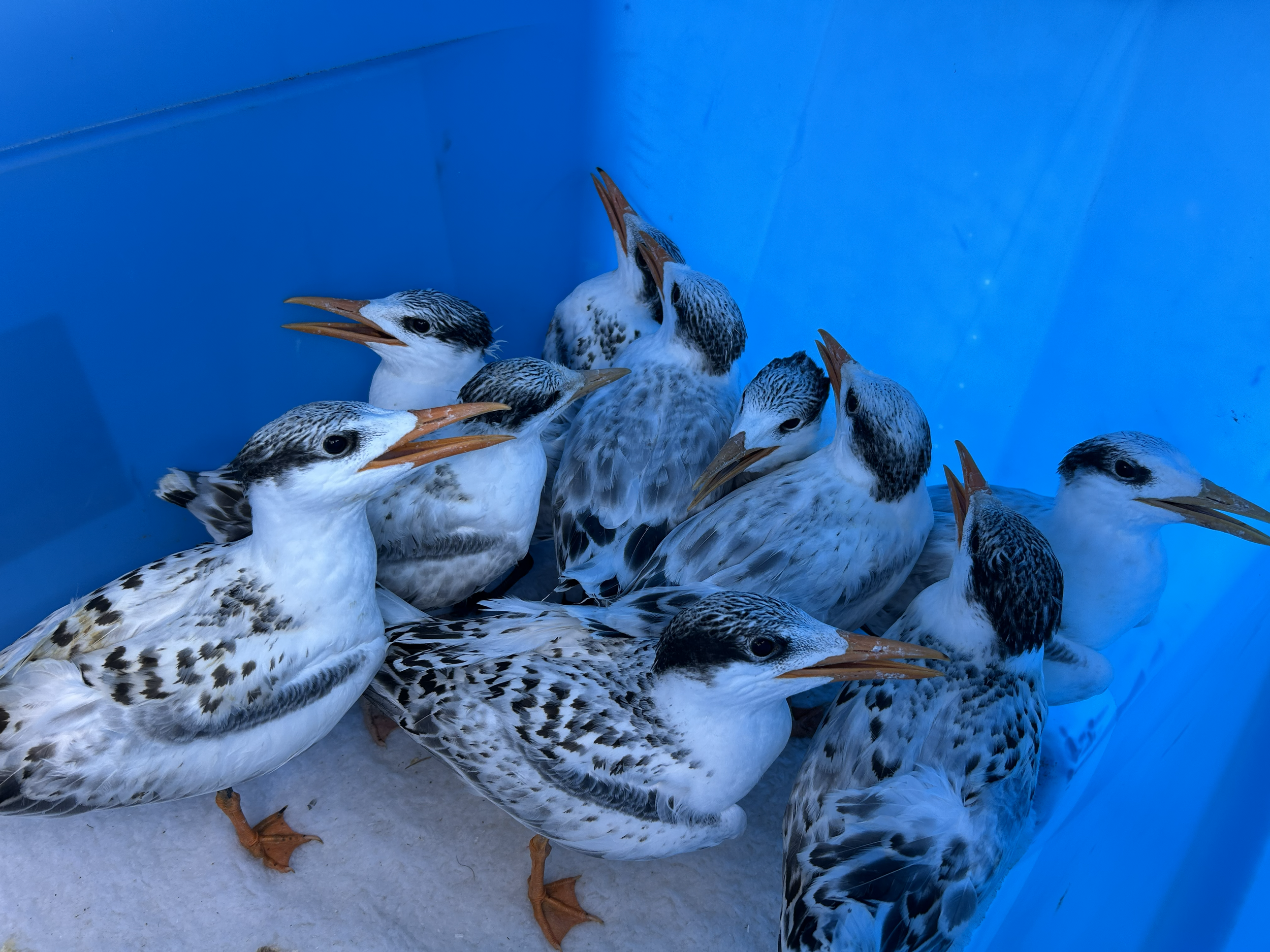

By 11 AM, our crew had banded more than 750 terns. Though the parents of these chicks didn’t need a unique band to pick them out of a crowd of thousands, scientists and birders will now be able to identify each one as an individual with its own life story. Birders who spot a banded bird should attempt to note or take a photo of the band number to report to the Bird Banding Laboratory, where someone will even reply with an email noting where and when the bird was banded. How cool is that?
Like other crested tern species, the tern chicks on Bird Island will be fed for several months by their parents, who will even accompany them south to wintering areas. When the adults head north again to breed in spring, juveniles will typically linger a year or two on their wintering grounds before returning to breed. Terns remain social in the non-breeding season, often congregating in huge flocks with other terns and gulls.
Like bird populations across every biome, terns and other seabirds are threatened by numerous factors such as climate change and habitat loss. Banding projects like the one managed by GA DNR are integral to understanding human impacts and making informed conservation decisions. Since these birds play a vital role in maintaining healthy coastal ecosystems by controlling prey populations, facilitating nutrient recycling, supporting biodiversity, and more, their conservation is connected to our own health and wellbeing as well.
Getting to spend a morning up close with thousands of Royal Terns and other coastal birds was an experience that will hold a place among my best memories of days in the field, in spite of the droppings covering my clothes. I was honored to be included among the volunteers and hope to help out again in the future. Thanks to GA DNR’s ongoing efforts to protect and steward important nesting sites like Bird Island, as well as to individuals who voiced their support for these protections, the Governor of Georgia has recently signed an order designating DNR as the explicit custodian of Bird Island and other important dredge sites. You can help protect the last wild places that support birds and other wildlife by staying up-to-date on upcoming public comment periods at: georgiawildlife.com/regulations/meetings.
